Last Call for the Last Chorus: When City Code Co-Writes the Set
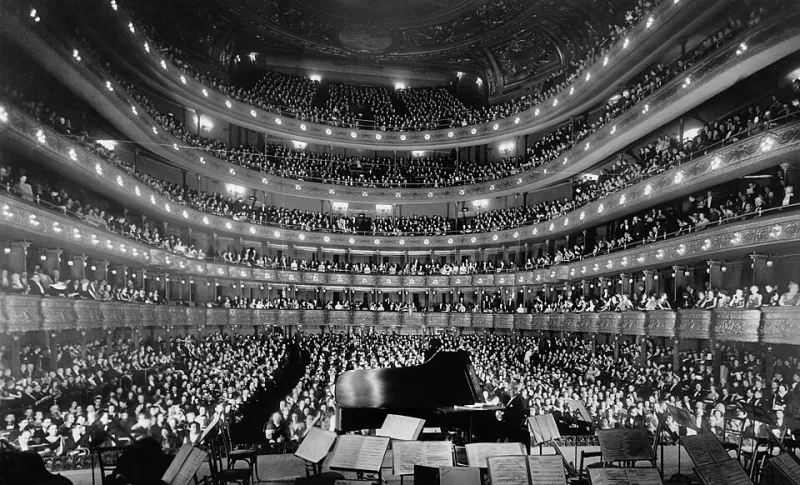
Photo: Unknown or not provided Retouched by Mmxx, Public domain, via Wikimedia Commons
At 10:58 on a Thursday in a 1,400-cap room in Chicago, the band is 90 seconds into a song they have played a thousand times. The singer is fine. The drummer is fine. The tour manager is not. She is standing by the monitor desk with a phone in one hand and a setlist in the other, doing the arithmetic that decides whether this song gets a second chorus or a hard cutoff. The house lights are still down. The crowd has no idea that the night is being edited in real time.
That is the curfew. Not the sign on the loading door, not the line in the rider — the actual, enforceable deadline that tells a room when the sound has to stop. In the US, that deadline is a patchwork of city ordinances, venue licenses, neighborhood agreements, and the occasional visit from a code officer with a decibel meter. And in 2026, as tours get tighter and rooms get more careful, the curfew has quietly become one of the most influential creative constraints in live music.
The Clock Is an Instrument
There are two kinds of curfew most artists deal with. The first is hard: sound off at a specific minute, or the venue risks fines, a suspended license, or a very bad conversation with the city. The second is soft: a fine that escalates the longer you go, which means the deadline is really a price list. Either way, the effect on stagecraft is the same. The last fifteen minutes of a set are no longer just music. They are negotiation.
"You learn the local alphabet fast," says Dana Ruiz, a tour manager who has spent the last six years routing indie acts through the Midwest and Southeast. "Austin is not Nashville. Nashville is not Atlanta. Atlanta is not a 300-cap room in a residential neighborhood that has a 10:30 hard out because the alderman got tired of complaints. Every city has its own grammar, and if you don't speak it, you lose songs."
That grammar is often invisible to the audience. A hard curfew at 11 p.m. means a headline set that ends at 10:40 if you want a real encore. A soft curfew with a steep fine means the encore might happen, but someone is doing math about whether the room can absorb the cost. A decibel-based rule — common in Los Angeles and parts of the Bay Area — means the deadline isn't just time, it's volume. Play loud and you may hit the limit early. Play quiet and you may get a few more minutes. The mix becomes a clock.
The Encore Math
Most fans think of the encore as spontaneous. Most tour managers think of it as a scheduled slot with a contingency clause. If the set ends at 10:38 and the curfew is 11:00, you have room for a two-song encore with a short pause. If the set ends at 10:52, you have room for one song and no pause at all. If the set ends at 10:58, you have room for a wave.
"We build the setlist backwards from the curfew," says Marcus Bell, a production manager who works with touring acts in the 800-to-3,000-cap range. "The closer is fixed. The song before the closer is fixed. Everything in the middle is elastic. If we're running long, we cut from the middle, never the end. The end is the promise."
The promise is the last song. It is the one people hum in the parking lot. It is the one that gets clipped for social video. It is the one that determines whether the night felt like a full statement or a truncated one. And under a hard curfew, the last song is chosen less for artistic resolution than for its ability to land cleanly and get the band offstage without a fade.
That is why so many 2026 setlists feature what crews call a "walk-off closer" — a song with a definitive ending, no long outro, no extended jam, no feedback wash. The fade is a luxury. The jam is a liability. The hard stop rewards the song that knows how to stop.
Songs Built for a Hard Stop
Listen closely to the final ten minutes of a curfew-constrained show and you can hear the architecture. The penultimate song is often mid-tempo, a chance to catch breath and reset the room. The closer is either a big singalong — something the crowd can carry if the band has to cut early — or a short, sharp burst that leaves the audience wanting more rather than checking the time.
Some artists have started writing with this in mind. "I have a song that is three minutes and ten seconds on the record," says Lila Grant, a Nashville-based songwriter who tours with a five-piece band. "Live, it used to stretch to six. Now we play it at album length because it's our curfew song. If we're at 10:47, we can still do it. If we're at 10:52, we can't. Knowing that changes how you arrange."
There is also the reverse: the song that gets cut. Every tour manager has a story about the one they had to drop because the room ran long, the opener went over, or the changeover ate fifteen minutes. "You never tell the crowd," Ruiz says. "You just don't play it. And then you see the signs in the front row asking for it, and you have to look past them."
The Local Alphabet
Touring bands in 2026 carry a kind of informal curfew bible — a shared document, often a spreadsheet, sometimes just a group chat, that tracks which rooms have which rules. Red Rocks has its own well-known cutoff. Chicago's weeknight rules push many headline sets to an 11 p.m. hard out. Boston's licensing realities shape how late a room can even stay open. Austin's sound ordinance is a constant conversation. Los Angeles is a maze of conditional use permits. None of this is glamorous. All of it is stagecraft.
"The audience thinks the show is the setlist," Bell says. "The setlist is the plan. The curfew is the weather. You can plan all you want, but you have to play the weather."
That weather is getting less predictable. As cities balance nightlife economies against residential complaints, more venues are operating under negotiated agreements that can change with a single council meeting. A room that had a midnight curfew last year might have an 11:30 hard out this year. Artists who route tours months in advance are making decisions about closers before they know the rules of the room they'll play.
What the Last Chord Decides
The curfew is not the enemy of the show. It is a constraint, and constraints have always shaped art. A sonnet has fourteen lines. A short set has forty-five minutes. A hard out at 11 p.m. has a last song. The question is not whether the clock is involved. The question is whether the artist lets the clock write the ending or writes it themselves.
The best closers under curfew feel intentional. They are short, they are clean, and they leave a mark. They are not the song the artist wanted to play at 11:15 in a room with no rules. They are the song that fits the night as it actually exists. And sometimes, when the crowd is loud and the band is locked in and the tour manager gives the nod at 10:49, the curfew song becomes the one people remember — not because it was the plan, but because it was the choice.
The house lights come up. The room exhales. Somewhere a code officer checks a watch and decides not to write anything down. The last chord is still ringing. That is the whole job.