Silhouette First, Song Second: The Art of the Entrance

Photo by Photo by Jasper Bennett on Unsplash on Unsplash
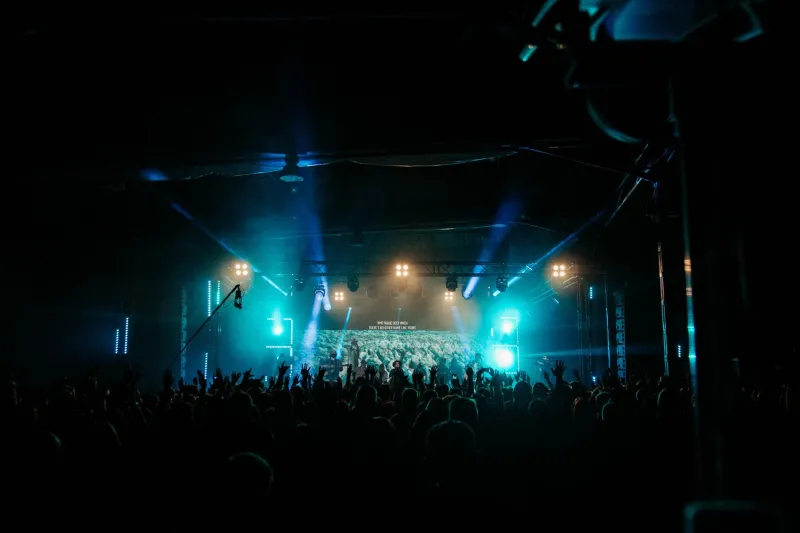
At 8:57 p.m. in a Chicago club, the headliner is still behind a black curtain. The house playlist fades mid-song. A stage hand walks across the deck, checks a cable, and disappears. Nobody has played a note, but the room has already changed. Conversations drop half a volume. Phones go down. The walk-on has started.
That ninety-second stretch—house lights, intro tape, stage hands, first silhouette—used to be treated as logistical dead air. Now it’s blocking. Tour managers build it into the run sheet. Lighting designers cue it like a song. Artists rehearse the pace of their first steps. The entrance is not the preface to the show. It is the first scene.
The Ninety-Second Scene
A walk-on works because it gives the audience a job: watch, wait, lean in. The house music fades, the stage goes dark, and the room gets a small puzzle. Is that the band? Is that the artist? Why is someone moving a monitor? The answer arrives in silhouette, and by then the crowd is already invested.
Dana, a tour manager who asked me to use only a first name, calls the walk-on 'the handshake before the handshake.' She plans it on the same grid as the setlist. 'If the intro tape is thirty seconds and the artist needs forty-five to get from the dressing room to the wing, the audience is standing in dead time,' she says. 'You either fill it with intention or you let it fill you.'
On a recent run through the Midwest, Dana built a two-part entrance: a low ambient loop under a stage blackout, then a single work light on the drum riser. The artist walked out during the loop, not after it. By the time the first song started, the crowd had already tracked the motion from wing to mic. No announcement. No hype speech. Just a room following a body.
Timing Is an Instrument
Lighting designers talk about the walk-on as a cue stack with its own emotional arc. Marcus, who designs for clubs and theaters in the Austin area, says the mistake is treating the entrance as a lighting state instead of a sequence. 'You don’t just turn the stage blue,' he says. 'You decide when the audience gets to see the artist’s face. That’s a reveal. That’s a line of dialogue.'
His usual build goes something like this: house lights to half, then a slow fade under a preset playlist; a backlight wash that turns the artist into a shape; a four-count of near-darkness; then a front light bump on the first note. The trick is the middle. Too much darkness and the crowd checks out. Too much light and the silhouette is gone before it lands.
Artists feel that timing in their bodies. Renee, a singer-songwriter who tours small theaters, says she used to sprint from the dressing room and arrive at the mic out of breath. Now she walks the same route during soundcheck, counts the steps, and gives herself a full minute of quiet at the wing. 'The first ninety seconds are not about me getting comfortable,' she says. 'They’re about the audience getting curious. If I rush that, I’m stealing from the first song.'
False Starts and the Cost of Dead Air
The walk-on is also where things go wrong in public. An intro tape skips. A stage hand crosses at the wrong moment. The artist waits for a cue that never comes, or walks early and stands in a pool of light while the band scrambles. Those false starts are not just awkward. They reset the room’s attention.
Dana keeps a short list of walk-on failures in her phone notes, not to shame anyone but to remember what the audience sees. A late tape means the crowd starts talking again. A missed lighting cue means the artist has to pretend the entrance was casual. A too-long pause means the room starts checking messages. 'Dead air is not neutral,' she says. 'It has a texture. The audience can feel the difference between a pause that’s building and a pause that’s waiting for a technician.'
The fix is usually not more production. It’s fewer moving parts and a clearer plan. Some artists now use a simple house-light dip and a single recorded voice note. Some use no tape at all—just stage hands clearing the deck in view of the crowd, then a blackout. The entrance can be elaborate or nearly bare, but it has to be owned. The worst version is the one that feels like the show is waiting for permission to begin.
The Silhouette Contract
There is a small contract between performer and audience in those first seconds. The room agrees to look; the artist agrees to arrive. The silhouette is the signature. It says someone is here, and the night is starting.
That is why the walk-on has become a place for storytelling. A lone figure at the edge of the stage. A band walking out together with house lights still up. A stage hand placing a glass of water on an empty stool. Each choice tells the room what kind of show this will be before the first chord confirms it.
In 2026, with touring costs high and rooms full of people who have seen a hundred entrances, the walk-on is a cheap, powerful tool. It does not require a bigger LED wall. It requires rehearsal, a run sheet, and respect for the pause. Sound, story, and stagecraft all start before the song.
What the Room Remembers
Ask people what they remember from a great show and they often describe the first moment, not the encore. The artist stepping out of the dark. The intro tape humming under the cheers. The half-second before the band kicks in. That is the walk-on doing its job.
The next time the house lights go down, watch the crowd instead of the stage. You will see the whole room make a decision. The entrance is the question. The first note is the answer. The best artists know how to hold the question just long enough.